
“The only way out of our wreckage is to rewrite the cultural script, to make excellence in character admired again.” ~ Peter Wehner
It’s hard to argue with his observation when we consider how the so-called powerful bend the rules and break the laws and face no real consequence for doing so.
It sends a clear message to the rest of us — integrity is for suckers.
But is it?
Peter Wehner, staff writer for The Atlantic, penned a beautiful article recently, titled:
“The Virtue of Integrity”
I have taken the liberty of including a short excerpt:
Integrity is a virtue on which good character is built. Other virtues can be admirable but isolated. One can be courageous in the pursuit of injustice. A person can be honest but ungenerous, forgiving but lazy. Al Capone, after all, sponsored a soup kitchen during the Great Depression.
Integrity—whose root word, integer, means wholeness, a thing complete in itself—assimilates other virtues. A person of integrity possesses an inner harmony, a moral coherence. As the philosopher Robert C. Solomon put it: “Integrity is not itself a virtue so much as it is a synthesis of the virtues, working together to form a coherent whole.”…
To be sure, people of integrity aren’t perfect. But they are individuals who possess an internal cohesiveness among distinct parts. Their values and behavior display a consistency that is the foundation of trust and mutual respect.
*****
Marsha is a great fan of Abraham Lincoln and reminds me when I need an illustration of a person with cultivated integrity, look no further than our 16th President.

I found this story that illustrates Marsha’s point.
In the early 1830s, when Abraham Lincoln was a young shopkeeper in New Salem, Illinois, he earned a reputation that would follow him all his life.
One evening, after closing his small general store, Lincoln counted the day’s receipts and discovered he had accidentally overcharged a customer—a woman who had purchased only a few simple items. The error was small, just a few pennies, but to Lincoln it mattered.
Rather than waiting until morning, he locked up the store, pocketed the coins, and set out on foot to find her. The woman lived miles outside the village, and the road was dark and uneven.
Lincoln walked for hours until he reached her modest cabin. Surprised to see him at her door so late, she asked if something was wrong.
Lincoln simply opened his hand and offered the coins.
“Ma’am,” he said, “I owe you this. I charged you more than I should have.”
She was astonished.
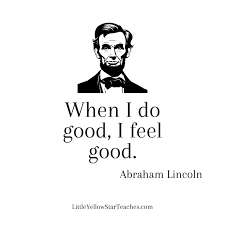
And, indeed, she should have been. Most merchants would have ignored the mistake, or never noticed it at all. But Lincoln believed that honesty was not a matter of convenience; it was a habit of character.
Every transaction, no matter how small, was a test of the kind of man he intended to be.
Lincoln understood something that shaped the leader he would become: Integrity is not built in grand moments, but in countless small choices.
He earned the moniker “Honest Abe” one quiet act at a time.
When you act with integrity
- You’re freed from pretending to be someone you’re not.
- Your soul and your actions finally “shake hands” in agreement.
- You never have to look over your shoulder; truth has no need to run.
- You’re filled with the joy of being able to live with yourself at the end of the day.
Doing the right thing may cost you something, but it always pays you back in clarity, calm, and self-respect.
In his essay “On Three Ways of Writing for Children,” C. S. Lewis, said,
“Since it is so likely that [children] will meet cruel enemies, let them at least have heard of brave knights and heroic courage. Otherwise you are making their destiny not brighter but darker.”
That we all might be reminded such a man once walked amongst us.
Just a thought…
Pat
Copyright © 2025 Patrick J. Moriarty. All Rights Reserved.