To read today’s post in its optimal format, please go to the Just A Thought website.
When Marsha and I arrived back in Seattle in 2017 I felt a little like Rip Van Winkle, waking up to a hometown I no longer recognized.
When I first left in 1971, times were tough.
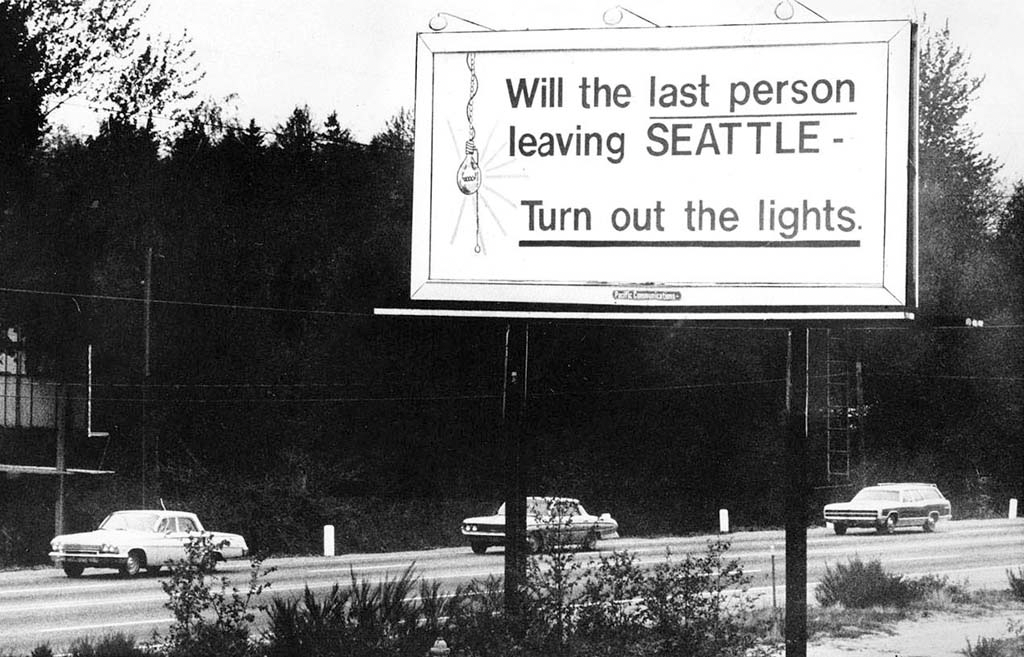
That old billboard said it all.
We returned to an area that was booming—fueled by a wave of new technology that created fortunes reminiscent of the Gold Rush.
Seattle had become a magnet for a new generation of smart, highly trained tech pros riding the crest of these opportunities.

At the same time, it now has the third-highest homeless population in the country and is in the grip of a devastating opioid epidemic.
Our return has felt, at moments, eerily like a long ago hangover.
What unsettled me most was how my old, hard-scrabble neighborhood of Queen Anne Hill had been transformed into an enclave of the wealthy—million-dollar bungalows, manicured gardens — with a sense of polish I didn’t quite recognize.
I felt lost and disoriented, a bit like an exile wandering through the ghost of a place I once knew.
And I’ll admit it: I found myself feeling old, bitter, and more than a little melancholy. I missed the old house I grew up in.

I resented the gentrification, resented the erasure of what once was. I looked in the mirror and saw, to my dismay, the beginnings of an angry, critical old man staring back.
Then an old memory surfaced and at once I became a boy again as I remembered a long ago lesson from a neighbor, Pauline Shaw.
Pauline and her husband Emmett lived two doors down from my childhood home. They were an older couple who bought their home shortly after it was built in 1923.
They had raised their one son on that dead-end street and when my parents bought our home in 1948 they had known everyone who ever lived on Lorentz Place.
Pauline baked cookies and taught piano; Emmett tended the best garden on the block. Together, they were our elders—steady, kind, and patient.
What I remember most was their gentleness.
They never scolded us for all the —
- windows we broke,
- apples we pinched,
- noise we made,
- fights we started.

We baby boomers were a force of nature—loud, numerous, and brimming with smart-aleck confidence.
The Shaws had grown up in a quieter era, when money was scarce and life moved slowly.
I often wonder how bewildering non-stop motion and restless energy must have seemed to them.
One memory stands out clearly.
After I knocked a baseball through their front window, shattering it, Mrs. Shaw came out, surveyed the damage, and called me over.
I apologized and promised I would replace the glass.
She waved it off, sat me down on the steps, and told me a story.
When she was a girl, an elderly woman lived on her block—a lonely, unhappy soul who complained about everything and scolded children for simply being children. Mrs. Shaw said that growing up on that street had been difficult because of her.
And when the old woman died, there were no tears—only the whispered relief of neighbors who were glad she was gone.
Pauline resolved that she would never become that woman. She told me she made three simple commitments:
- She would make friends with her neighbors.
- She would accept changes she didn’t understand.
- She would treat everyone with kindness.
Piano lessons became her way of getting to know the neighborhood kids.
Once she knew a child, she said, she formed a lifelong bond. Over the years, she never had trouble with her neighbors—they had all become friends, broken windows and all.
And so Pauline Shaw was never made an exile by time. Remembering her was the reminder I needed:
- Make friends with my neighbors.
- Accept that some changes I may never fully understand.
- Treat everyone with kindness.
My last memory of Mrs. Shaw is of how she found contentment in the sea of change around her.
Every now and then, when we baby boomers were booming a little too vigorously, a gentle, beautiful sound would drift over the neighborhood.
It was Pauline playing her piano—quieting us down and filling the block with a peace only she could summon. I especially remember one piece that touched me to my core — Claire de Lune, by Claude Debussy.
And she played it like a prayer.
The Serenity Prayer:

Just a thought…
Pat
In order to hear the music, please make sure you’re listening from the Just A Thought website.